

What Is Local Dentist SEO?
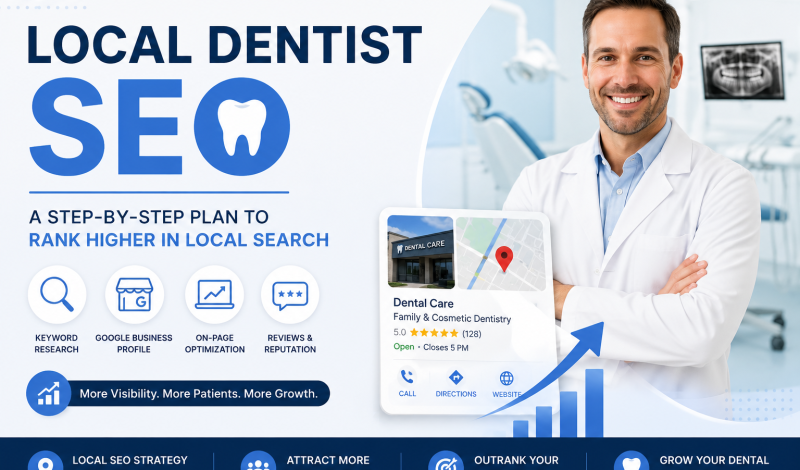
Local SEO for dentists focuses on improving a dental practice’s visibility in local search results, including Maps, Google Business Profiles, and organic results. When someone searches for “dentist near me” or “pediatric dentist in [city],” local SEO helps your practice appear in the top positions. The goal is to connect with patients who are actively looking for dental care in your area. Unlike general SEO, local SEO emphasizes location-specific signals such as your Google Business Profile, online reviews, and local citations. More than 60% of consumers use the internet to find a dentist near them, making local SEO a critical part of any modern dental marketing strategy.
Why Local SEO Matters for Dental Practices
Patients rely heavily on local search results when choosing a dentist. 86% of patients use Google Maps to find a dentist, and the Local 3-Pack captures 44% of all local search clicks. Practices ranking in the top three Google Map Pack positions receive 70% of all website clicks. Meanwhile, the #1 Google organic search result captures 33% of all clicks. These numbers show how important it is to rank both in the Map Pack and in organic results. Additionally, dental practitioners who invest in local SEO see an average return on investment of $3 for every $1 spent. 72% of customers tend to physically visit a small business located within five miles, and “dentist near me” has 2.2 million or more monthly searches. Ignoring local SEO means missing a large pool of potential patients.
Step 1: Optimize Your Google Business Profile
Your Google Business Profile is the foundation of local dentist SEO. This free listing appears in Google Maps and local search results. To optimize it, ensure your business name, address, and phone number are accurate and consistent across all platforms. Add your service areas, business hours, categories, and high-quality photos. Encourage patients to leave reviews on your profile, as reviews with 4+ stars get three times more clicks. Also respond to all reviews professionally. Google uses the information on your profile to determine relevance and proximity for local searches. A complete and active profile signals trustworthiness to both Google and potential patients.

Step 2: Build Consistent Local Citations
Local citations are online mentions of your dental practice’s name, address, and phone number (NAP) on directories, review sites, and other websites. NAP consistency boosts local pack rankings. Inconsistent information confuses search engines and can hurt your visibility. Start by listing your practice on major directories like Yelp, Healthgrades, and Facebook, then expand to dental-specific directories. Each listing should match your Google Business Profile exactly. Use the same format for your address and phone number everywhere. Citation building is a time-intensive process, but it is a proven factor in local search rankings. Tools like Moz Local or BrightLocal can help you manage consistency.
Step 3: Manage and Generate Patient Reviews
Online reviews are a powerful trust signal for both patients and search engines. 88% of patients trust online reviews as much as personal recommendations, and 72% of patients read reviews before choosing a dentist. A 1-star increase in Google ratings can lead to a 5-9% revenue boost. To generate more positive reviews, ask satisfied patients after their appointment through email, text, or a follow-up call. Make the process easy by providing a direct link to your Google review page. Avoid offering incentives for reviews, as that violates Google’s policies. Responding to all reviews, both positive and negative, shows that you value patient feedback. More reviews and higher ratings improve your chances of appearing in the Local 3-Pack.

Step 4: Create Locally Relevant Content
Adding location-specific content to your website helps search engines understand where you practice. Write blog posts about dental topics that matter to your local community, such as “Common Dental Issues in [City]” or “Best Teeth Whitening Options for [City] Residents.” Include local landmarks, neighborhood names, and references to community events. Also create service pages that target specific procedures you offer along with your city name. For example, “Invisalign in Austin” or “Emergency Dentist in Downtown Dallas.” This type of content aligns with the high volume of “dentist near me” searches and signals relevance to Google. Regular updates keep your site fresh and improve organic rankings over time.
Step 5: Use Local Link Building Strategies
Earning backlinks from local websites strengthens your practice’s authority in the eyes of search engines. Reach out to local business associations, chambers of commerce, and community organizations for link opportunities. Sponsor local events or sports teams and ask for a link on their website. Write guest posts for local health blogs or partner with other healthcare providers. Each backlink from a reputable local source tells Google that your practice is a trusted part of the community. While link building takes effort, it significantly boosts your local search performance when combined with other SEO tactics.
Local SEO vs. Google Ads for Dentists
Both local SEO and Google Ads can drive patients to your practice, but they work differently. The average cost per click for a Google Ads campaign is $2.32, while the average cost per click for a local SEO campaign is $0.64. Local SEO also delivers a typical $3 return for every $1 spent, while well-optimized Google Ads campaigns can see a 5X average return. SEO results take longer to build but provide compounding returns over time. Google Ads offers immediate visibility but requires ongoing budget. For most dental practices, a combination of both delivers the best results. Use local SEO to build long-term organic traffic and Google Ads to capture patients who need care right away.
How Long Does Local SEO Take to Show Results?
Many dental SEO clients notice improvement within 30 to 60 days. However, local SEO is not an instant fix. It takes time for Google to crawl and index changes to your Google Business Profile, citations, and website content. The first few months focus on laying the groundwork: optimizing your listing, building citations, and generating reviews. After that, you should see gradual increases in Map Pack appearances and organic traffic. Patience and consistent effort are key. Unlike paid ads, the benefits of local SEO grow over time and continue delivering patients without ongoing ad spend.
Frequently Asked Questions
How much does local dentist SEO cost?
Pricing for dental SEO services varies widely based on the agency and the scope of work. Some agencies charge monthly retainers, while others offer one-time setup fees. Contact individual providers for specific quotes. Local SEO for dentists typically includes Google Business Profile optimization, citation building, review management, and content creation, which all contribute to the overall cost.
Is local SEO or Google Ads better for my dental practice?
Both have advantages. Local SEO provides a higher long-term return on investment, with an average $3 return per $1 spent and a lower cost per click of $0.64. Google Ads delivers faster results and can generate immediate phone calls, with a potential 5X return. Many dental practices use both to capture patients at every stage of their search journey.
How important are online reviews for local SEO?
Reviews are very important. 88% of patients trust online reviews as much as personal recommendations, and 72% of patients read reviews before choosing a dentist. A 1-star increase in Google ratings can lead to a 5-9% revenue boost, and reviews with 4+ stars get three times more clicks. Actively managing reviews is a critical part of local dentist SEO.
What is a Google Business Profile and why does it matter?
A Google Business Profile is a free listing that appears in Google Maps and local search results. It displays your practice’s name, address, phone number, hours, photos, and reviews. Optimizing this profile is the most important step in local SEO because Google uses it to determine whether to show your practice in the Map Pack when someone searches for a dentist in your area.
Can I do local SEO myself or should I hire a professional?
You can handle basic tasks like claiming your Google Business Profile, asking for reviews, and ensuring NAP consistency. However, advanced local SEO involves technical audits, citation cleanup, link building, and ongoing monitoring. Many dental practices choose to work with an experienced agency to save time and achieve faster, more reliable results.